10 Asian American Love Stories to Read on Valentine's Day

IMG_7877.JPEG

The term Kundiman comes from the Tagalog phrase "kung hindi man," or "if it were not so." These Filipino love songs sang not just of love, but of love of country in a time of colonization and political unrest.

Adding to our collection of Kundiman Love Poems, we've curated this list of short stories, essays, and novels written by Asian American authors. These stories reconfigure, recomplicate, and reimagine love in our world today-– whatever form of love that may be. Like Kundiman, we hope that these voices, singing together, bring forth light and possibility.

This list is curated by 2020-21 Communications Intern Helli Fang.

I am “queer” for two reasons — because I am gay and because my body — a half-Pakistani body by law if not by blood or ancestry — lies out the mainstream of what the mother country now considers acceptable.

I long to come home, to come home and be welcomed, to be welcomed and held, to be held and known.

––from “A Letter from an Indian in Exile” by Kazim Ali

The girl and I share a bowl of watermelon on the sidewalk, the juice steaming warm as our bowels. We eat the meat, suck out its lineage of seeds, and spit them as far as we can at the cars at the sun at the squirrels at the lampposts at the stray cat at the house across the street with its white cactus garden, its orchard of bones. In her mouth, seedlight. The shape of the seed’s future body: mine. We aim our mouths, shotgunning the seeds across the street. They mature mid-air and land on the far sidewalk, full-grown watermelons spilling soft rubies of meat, sweet before we know the word for it.

––from “Consequences of Water” by K-Ming Chang

Their romance has started in earnest this summer, but the prologue took up the whole previous year. All fall and spring of the previous year they lived with exclusive reference to each other, and were viewed as an unspoken duo by everyone else. Little remarked, universally felt, this taut, even dangerous energy running between them. 

––from Trust Exercise by Susan Choi

I am the kind of person who is always coming to a precipice in her life. She must sit quietly there. The idea of herself, the person she needed herself to be in order to be okay, has fallen apart. In the last seven or so years I have come to this precipice over and over again. I wanted a different kind of life, a life as fortress. My mother wanted me to have this kind of life: she wanted me to be safe.

––from “Safe House” by Shamala Gallagher

For me, writing poems is a way of breaking that cage, a way to have the unicorn become the narwhal become the speaker become the writer become the reader all at once. It is a resistance to colonial forms of Imaginary takeover—a rebuke of having my dream space occupied by measures that insure that what the United States calls a chair is a chair. Sometimes a chair is a kursi, a pirha, a golposh, a saddle, a chariot. I want to ride the possibilities of what a chair can be into the darkest shadow of Lemuria, or across the galaxies.

––from “Unicorns, Narwhals, and Poets” by Rajiv Mohabir

It’s true that if you cry hard enough for long enough you can end up with blurred vision.

I was lying down, it was the middle of the day, but I was in bed. All the crying had given me a headache, I’d had a throbbing headache for days. I got up and went to look out the window. It was winter yet, it was cold by the window, there was a draft. But it felt good—as it felt good to press my forehead against the icy glass. I kept blinking, but my eyes wouldn’t clear. I thought of the women who’d cried themselves blind. I blinked and blinked, fear rising. Then I saw you.

––from The Friend by Sigrid Nunez

He kisses her. She returns with a sudden heat. The scent of incense, bergamot perfume. They are already lying down on her bed. Some of their clothes are tossed to the side. He can feel the arch of her body, pressing closer against his. He wants to be overwhelmed. He wants to give in. But he feels himself pulling away.

“What’s the matter?” The flash of unease in her eyes cripples him further. “What’s wrong?”

“I’m sorry. I want to, I really do.” 

“Okay?”

“I just can’t.” 

––from “Enlightenment” by William Pei Shih

I marry a man when winter ends. Our wedding is private and tastes like burnt sugar spilled over snow. My husband smells like cedar trees and coffee and I have fallen for the cleanliness of his light blue eyes. Our counters are never sticky and our meals paired with wines that all taste the same, but they go well with the chicken breast that has been trimmed of its fat and skin and flavor. Could I get more salt? I ask the waiter at the restaurant near the university. And pepper? I think of my mother but I still do not call. I have not seen her in five years but if I saw her again, I would sniff her sleeve the way I did as a child.

––from “Fish Paste” by Nay Saysourinho

Mama taught me everything: how to dress, draw my eyebrows, pencil in my lips, articulate, sit up straight and like a lady, cross my legs, command a room, distract a stranger if he insulted me, laugh, make friends, debate, trust my intellect, fight for my intellect.

––from “Remembering My Lola By Teaching Myself How to Cook” by Melissa R. Sipin

For once, I won’t be one of those poets who say: What I’m trying to say is. No, this time I just say it, ruthlessly sentimental. Without hesitation or simile or metaphor: “I love you.”

And when he says it back to me, slowly, like dipping a toe in a needle-cold lake, I imagine all the mosquitoes in the world bowing their glassy wings.

––from “To Love a Mosquito” by Jane Wong

Available for Pre-Order: Shahr-e-jaanaan: The City of the Beloved

Talukder-Shahr-e-Jaanaan-Front.jpg

We're so excited to share that Kundiman Poetry Prize Winner Adeeba Shahid Talukder's poetry collection, Shahr-e-jaanaan: The City of the Beloved is available for pre-order!

Shahr-e-jaanaan sets out to recreate the universe of Urdu and Persian poetic tradition. As the speaker maps her romances onto legends, directing their characters perform her own tragedy, their fantastical metaphors easily lend themselves to her fluctuating mental state. Cycling between delirious grandeur and wretched despair, she is torn between two selves— the pitiable lover continually rejected, and the cruel, unattainable beloved comparable in her exaltation to a god.

Fellow Tarfia Faizullah writes about the collection:

I stayed in a perpetual state of goosebumps while reading Adeeba Talukder’s debut collection, Shahr-e-jaanan, no lie. Maybe because the settings evoked are familiar and tangible but also magical, otherworldly. Maybe it’s that I fell, despite myself, captive to the spells of its stories—Scheherezade and her command over wild nights of imagination come to mind. Maybe it’s the way Talukder manages to both evoke Urdu poetic tradition and create her own—these poems swoon with the restrained sensuality of the old world while dancing with the glittering passions of the new. Let yourself get caught up in this book’s wondrous whorls and whirls—you won’t regret it.

Preorder here! Available March 1, 2020.

talukder.jpg

Adeeba Shahid Talukder is a Pakistani American poet, singer, and translator of Urdu and Persian poetry. She is the author of What Is Not Beautiful (Glass Poetry Press, 2018) and her book Shahr-e-jaanaan: The City of the Beloved, is a winner of the Kundiman Poetry Prize. Her poetry has appeared in Poem-A-Day, Gulf Coast, Meridian, The Margins, and elsewhere. A Best of the Net finalist and a Pushcart nominee, Adeeba holds an MFA in Creative Writing from the University of Michigan and is the recipient of an Emerging Poets Fellowship from Poets House.

Mentorship Lab Applications Open!

"The Mentorship Lab was a lifechanging fellowship. I went from feeling like an isolated person who writes to a writer. The validation and support that the program gave me is something money cannot buy. The relationships I formed with my mentor and cohort will last far beyond the length of the fellowship and I will take this experience with me as I continue my literary journey." ––Julie Kim, 2019 Creative Nonfiction Mentorship Fellow

Mentorship Lab 2020 Graphic 1.png

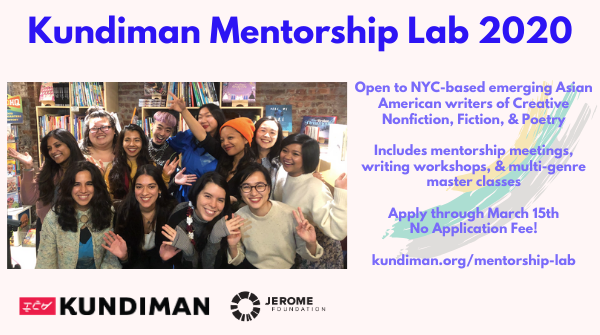
Applications for our 2020 Mentorship Lab are now open, and we are thrilled to have Hala Alyan, Gina Apostol, and Mayukh Sen serving as this year's Mentors! The Mentorship Lab will support 9 emerging writers through a six-month program. The Mentorship Lab supports 3 writers of each genre (Creative Nonfiction, Fiction, & Poetry), who will take Master Classes, Workshops, and receive one-on-one Mentorship.

The Mentorship Lab is open to emerging writers who self-identify as Asian American. Writers must not have published a full-length book by the conclusion of the Lab, and cannot be enrolled in a degree-granting program during the time of the Mentorship Lab. Writers must be residents of the five boroughs of New York City, and be living in NYC for the full period of the Mentorship Lab. We are grateful to The Jerome Foundation for their support of this program.

Find more information and apply here! Applications close on March 15th.

2020 Kundiman Retreat Applications Are Now Open!

"I've always heard, read, and spoken about the importance of community in any artistic endeavor. The poet's road can be a lonely one; the drifting heart needs its anchors. But I never realized how empowering a community of artists could be until I spent four days with the Kundiman staff, teachers, and Fellows. I found there what I failed to find in my MFA program, or in any other poetry workshop I've taken: a deep respect and honor among poets; a desire to talk about race, identity, and history, in conjunction with one's composition process; and a willingness to be brave, to fail, and to look silly." ––Brynn Saito, Kundiman Retreat Fellow

Applications are now open for the 2020 Kundiman Retreat! With Master Classes and Mentorship from six nationally renowned Asian American poets and fiction writers, the Kundiman Retreat works to mentor the next generation of Asian American writers.

  • Location: Fordham University, Rose Hill Campus
  • Retreat Dates: June 24th–June 28th
  • Application Period: December 1st–January 15th

Fiction Faculty: Nayomi Munaweera, Madeleine Thien, & Vu Tran

Poetry Faculty: Jenny Boully, Philip Metres, & Matthew Olzmann

Find out more about the application process here. You can also read more testimonials from past and current Fellows.

Good luck, and we're so excited to read your submissions!

Kundiman Presents Our 2020 Retreat Faculty!

Get your applications ready: The 2020 Retreat is coming up! We're thrilled to share our faculty for the next Retreat with you.

For Fiction, Nayomi Munaweera, Madeleine Thien, and Vu Tran will be teaching. In Poetry, we have Jenny Boully, Philip Metres, and Matthew Olzmann. We're so excited for the 2020 Fellows to be in community with these talented writers this June!

The Retreat will take place at the Fordham University Rose Hill Campus from June 24th to June 28th. Applications will be open from December 1st–January 15th.

FICTION

Nayomi Munaweera is a critically acclaimed, internationally award-winning novelist. Amongst many honors, her debut novel Island of a Thousand Mirrors won the Commonwealth Book Prize for the Asian Region while her second novel What Lies Between Us, won the Sri Lankan National Book Award. She is published extensively in print and on-line.The Huffington Post has raved, “Munaweera’s prose is visceral and indelible, devastatingly beautiful-reminiscent of the glorious writings of Louise Erdrich, Amy Tan and Alice Walker, who also find ways to truth-tell through fiction.” The New York Times Book Review has called her work, “incandescent.” She lives in Oakland where she is finishing her third novel, a psycho-sexual literary thriller.

Madeleine Thien.jpg

Madeleine Thien is the author of four books, including Dogs at the Perimeter, and a story collection, Simple Recipes. Her most recent novel, Do Not Say We Have Nothing, was shortlisted for the 2016 Man Booker Prize, the Women’s Prize for Fiction, and The Folio Prize; and won the 2016 Scotiabank Giller Prize and the Governor-General’s Literary Award for Fiction. The novel was named a New York Times Critics’ Top Book of 2016 and long-listed for a Carnegie Medal. Madeleine's books have been translated into twenty-five languages and her essays and stories have appeared in The New York Times, The Guardian, Brick, frieze, Granta, and elsewhere. She lives in Montreal and is a Professor of English at Brooklyn College.

Vu Tran.jpg

Vu Tran's first novel, Dragonfish, was a NY Times Notable Book and a San Francisco Chronicle Best Books of the Year. His short fiction has appeared in the O. Henry Prize Stories, the Best American Mystery Stories, Ploughshares, and other publications. He is the winner of a Whiting Writers’ Award and an NEA Fellowship, and has been a fellow at Bread Loaf, Sewanee, MacDowell, and Yaddo. Born in Vietnam and raised in Oklahoma, Vu received his MFA from the Iowa Writers’ Workshop and his PhD from the Black Mountain Institute at the University of Nevada, Las Vegas. He is a criticism columnist for the Virginia Quarterly Review, and is currently an Assistant Professor of Practice in English & Creative Writing at the University of Chicago, where he is also Director of Undergraduate Studies.

POETRY

Jenny Boully.jpg

Jenny Boully is the author of Betwixt-and-Between: Essays on the Writing Life. Her previous books include not merely because of the unknown that was stalking toward them, The Book of Beginnings and Endings: Essays, [one love affair]*, of the mismatched teacups, of the single-serving spoon: a book of failures, and The Body: An Essay. A ลูกครึ่ง (half-child), she was born in Thailand and grew up on the southwest side of San Antonio, Texas. She attended Hollins University, where she double majored in English and Philosophy and then went on to earn an MA in English Criticism and Writing. Her other degrees include an MFA in Creative Writing from the University of Notre Dame and a Ph.D. in English from the Graduate Center of the City University of New York.

Philip Metres.jpeg

Philip Metres has written ten books, including Shrapnel Maps (Copper Canyon 2020), Sand Opera (Alice James 2015), Pictures at an Exhibition (2016), and The Sound of Listening: Poetry as Refuge and Resistance (2018), among others. Awarded the Lannan Fellowship, three Arab American Book Awards, two NEAs, and the Adrienne Rich Award, he is professor of English and director of the Peace, Justice, and Human Rights program at John Carroll University.

Matthew Olzmann.jpg

Matthew Olzmann is the author of two collections of poems, Mezzanines, which was selected for the 2011 Kundiman Prize, and Contradictions in the Design, both from Alice James Books. His third book, Constellation Route, is forthcoming in January 2022. He’s received fellowships from Kundiman, the Kresge Arts Foundation and the Bread Loaf Writers’ Conference. His poems, stories, and essays have appeared in Best American Poetry, Kenyon Review, New England Review, Necessary Fiction, Brevity, Southern Review and elsewhere. He teaches at Dartmouth College and in the MFA Program for Writers at Warren Wilson College.

Kundiman Featured on Poetry Foundation's VS Podcast

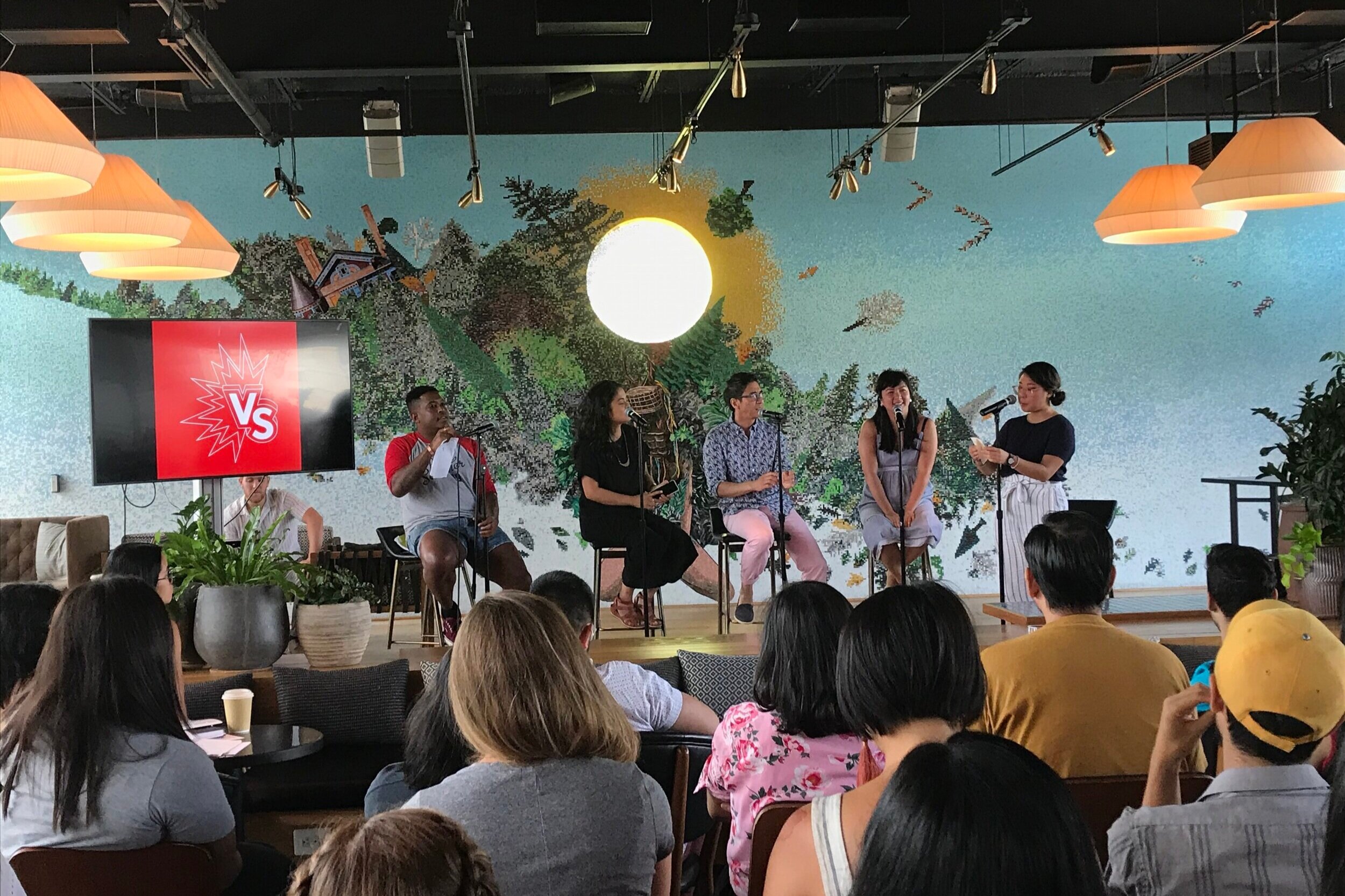
VS Podcast Live event at the 2019 Asian American Literature Festival. Photo by Kyle Lucia Wu.

VS Podcast Live event at the 2019 Asian American Literature Festival. Photo by Kyle Lucia Wu.

VS Podcast, a bi-weekly poetry podcast hosted by Danez Smith and Franny Choi, released an episode recorded live at the 2019 Asian American Literature Festival. The episode featured Kundiman’s Executive Director Cathy Linh Che and co-founders Joseph O. Legaspi and Sarah Gambito.

Each guest read two poems and discussed topics such as love, solidarity, queerness, and poetry. Che, Legaspi, and Gambito also spoke on Kundiman’s mission, emphasizing the sense of generosity and care that is nurtured within its community. When asked about passing along Kundiman to new leadership, Gambito responded:

“The number one reason why nonprofits fail is founder’s syndrome. I love Kundiman so much, I can’t let that happen–– Joseph and I can’t let that happen. I think part of bringing up a leader, it’s bringing up other leaders. It can’t just be about you. You have to understand how [Kundiman] has a life and breath of its own, and to find guardians, and people with imagination that are aligned with you.”

Listen to the episode here!

VS Podcast Live event at the 2019 Asian American Literature Festival. Photo by Hannah Colen.

VS Podcast Live event at the 2019 Asian American Literature Festival. Photo by Hannah Colen.