
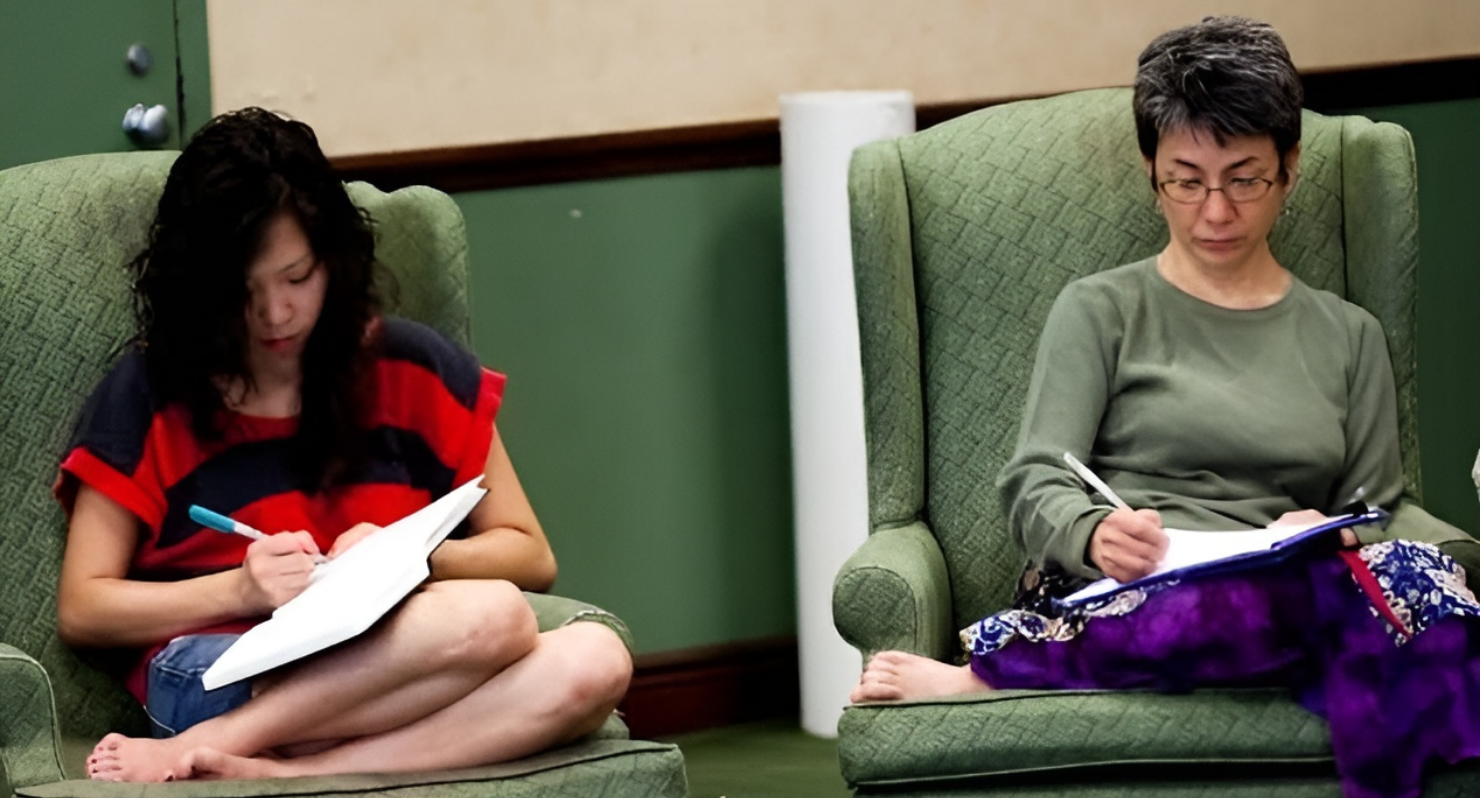
The 2011 Kundiman Retreat. Photo courtesy of Eugenia Leigh.
I attended my first Kundiman retreat in 2011 just before I turned 27. After several previous rejections, this retreat entered my life during a time post-MFA when I had largely given up on writing. The year prior, soon after I experienced my first journal publications, my father found some of my poems online and began to harass me, sending numerous emotionally abusive emails and creating anonymous Twitter accounts to attack my writing in public. I shelved the manuscript I had been sending out and decided I couldn’t continue.
I don’t remember what pushed me to share this, crying, with the large group on the first night of that Kundiman retreat. We were seated in a circle. Everyone took turns sharing about their writing journey and what brought them to the retreat, which meant many shared openly about their pain. Another fellow’s parent had passed. Another fellow had endured a years-long depression. My grief, now part of a collective of losses, felt manageable in this space and, more importantly, deeply understood. My Asian American peers “got,” right away, what it meant to vacillate between wanting to write emotionally resonant, truthful poems versus wanting to protect our parents. But more crucially, it was the Asian American “elders” in the room such as Kimiko Hahn and Oliver de la Paz who offered me the “permission” I needed to return to my path as a poet. I would not have my father’s blessing, but I had theirs, and this support was instrumental. Their wisdom and mentorship freed me from self-censorship.
I am in my 40s now — a mother with two published books, teaching both in community organizations and in an MFA program — and I still cry when I think back to that first retreat. Writing poems is such a vulnerable and solitary act, and many of us begin this journey alone, fearful, unsure, while facing discouragement from loved ones, from capitalism, from our bank accounts, from our own internal critics. And yet, we also turn to poems to survive all that grief, uncertainty, and fear. Poetry (yes, I have to say it) can be life changing. It follows, then, that supporting someone’s growth as they come into their power as a poet is necessary and vital.
Could I have become the poet I am today without Kundiman? Maybe. But I would not have felt as safe or as buoyed. I likely would not have been as bold. The friends I made through Kundiman have offered me much-needed encouragement on this strange road. They’re the ones with whom I embarked on a whirlwind debut book tour. They’re the ones I text when my most insecure self resurfaces.
When I encourage my Asian American students to apply for a Kundiman fellowship, I tell them that a rejection isn’t a reflection of their talent. It’s a reflection of a lack of resources, a lack of space. I dream of a future in which a community like this will be available to all Asian American poets and writers. I hope you’ll join me in continuing to champion Asian American voices by making this path more financially accessible for all.
— Eugenia Leigh, Kundiman Fellow